
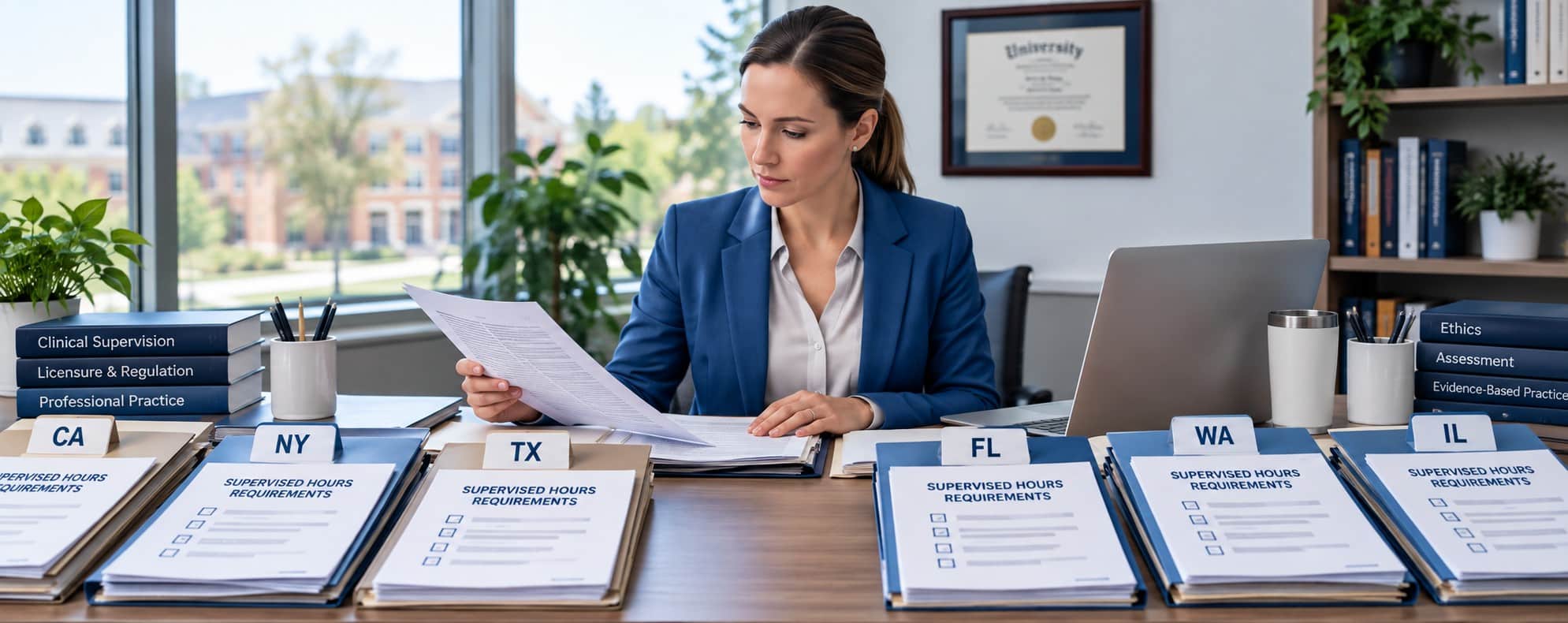
Requirements for supervised experience vary significantly across states. Some jurisdictions require a defined period after the doctoral degree, while others allow qualifying predoctoral experience to count toward all or part of the requirement.
The state-by-state table below compares postdoctoral and total supervised-experience requirements for initial psychologist licensure. Because hours alone do not determine whether an experience qualifies, applicants should also review each licensing board’s rules for timing, supervision and documentation.
Do All States Require Postdoctoral Supervised Hours for Psychology Licensure?
No. Requirements for postdoctoral supervised hours for psychology licensure vary by jurisdiction. Although the Association of State and Provincial Psychology Boards reports that a majority require two years of supervised experience—typically a doctoral internship and a year after receiving the doctoral degree—some states permit applicants to satisfy the requirement partly or entirely through qualifying predoctoral experience.
A doctoral internship and postdoctoral experience are not necessarily interchangeable. Even after completing the required number of hours, an applicant must meet the jurisdiction’s rules for when and how the experience was obtained, supervised and documented. The licensing board makes the final determination of whether an experience qualifies.
Postdoctoral Supervised Hours for Psychology by State
The table below summarizes requirements for postdoctoral supervised hours for psychology licensure in all 50 states and Washington, D.C. It distinguishes each jurisdiction’s total supervised-experience requirement from the portion that must occur after the doctoral degree.
- Required: A specified amount of qualifying experience must ordinarily occur after the doctoral degree.
- Flexible: Supervised experience may be divided between predoctoral and postdoctoral periods or completed without a fixed postdoctoral minimum.
- Not separately required: Supervised experience is required, but the jurisdiction does not ordinarily mandate a distinct postdoctoral component.
- Conditional: The answer depends on the applicant’s pathway, degree, internship or another material factor.
Requirements were reviewed for publication in 2026 but may change. Confirm current rules directly with the licensing board before beginning or submitting supervised experience.
| State or jurisdiction | Classification | Minimum postdoctoral experience | Total supervised experience | Important conditions |
| Alabama | Required | 1 year | 2 years | Ordinarily requires one qualifying internship year and one year of supervised postdoctoral experience. |
| Alaska | Required | 1 year | 2 years | Alaska specifies one year of postdoctoral supervised experience but does not assign it a fixed hourly equivalent. |
| Arizona | Flexible | No separate minimum | 3,000 hours | At least 1,500 hours must come from a qualifying internship; remaining hours may be accumulated through other qualifying supervised experience. |
| Arkansas | Required | 2,000 hours | 4,000 hours | Requires a qualifying 2,000-hour internship (at least 25% direct client contact) and 2,000 hours of postdoctoral supervised experience. |
| California | Required | 1,500 hours | 3,000 hours | Up to 1,500 hours may be earned before the doctoral degree; at least 1,500 must ordinarily be completed postdoctorally. |
| Colorado | Required | 1,500 hours | 3,000 hours | Requires 1,500 qualifying postdoctoral hours in addition to the supervised doctoral internship or equivalent experience. |
| Connecticut | Flexible | No separate minimum | Internship plus 1,800 hours | Requires at least 1,800 hours of supervised experience at the pre-doctoral or post-doctoral level; the doctoral internship itself cannot be counted toward these hours. |
| Delaware | Required | 1,500 hours | 3,000 hours | Requires 1,500 internship hours and 1,500 hours of supervised postdoctoral experience. |
| District of Columbia | Required | 2,000 hours | 4,000 hours | Ordinarily requires 2,000 internship hours and 2,000 hours completed after the doctoral degree. |
| Florida | Required | 2,000 hours | 4,000 hours | Requires 2,000 hours of doctoral internship experience and 2,000 hours of postdoctoral supervised experience. |
| Georgia | Required | 1,500 hours | 3,500 hours | Requires a 2,000-hour internship and 1,500 hours of supervised postdoctoral experience. |
| Hawaii | Required | 1,900 hours | 3,800 hours | Requires a 1,900-hour doctoral internship and 1,900 hours of postdoctoral supervised experience. |
| Idaho | Required | 1,000 hours | 2,000 hours | At least 1,000 hours must ordinarily be completed after the doctoral degree; qualifying predoctoral experience may count toward the balance. |
| Illinois | Required | 1,750 hours | 3,500 hours | Requires a 1,750-hour internship and a distinct postdoctoral year of at least 1,750 hours; additional predoctoral experience cannot substitute for the postdoctoral requirement. |
| Indiana | Flexible | No separate minimum | 3,100 hours | Requires a 1,500-hour internship; the remaining 1,600 hours may come from practicum, post-internship, or postdoctoral experience — a formal postdoctoral placement is not required. |
| Iowa | Required | 1,500 hours | Internship plus postdoctoral year | Requires a qualifying internship and at least 1,500 hours of postdoctoral supervised professional experience. |
| Kansas | Required | 1 year | 2 years | One supervised year is generally the internship; the second must ordinarily occur after completion of doctoral requirements. |
| Kentucky | Flexible | No separate minimum | 3,600 hours | Requires a 1,800-hour internship; the remaining 1,800 hours may be predoctoral, postdoctoral, or a combination. |
| Louisiana | Required | 2,000 hours | 4,000 hours | Requires a 2,000-hour internship and 2,000 hours of postdoctoral supervised experience. |
| Maine | Required | 1,500 hours | 3,000 hours | Requires at least 1,500 internship hours and 1,500 hours of supervised experience after the doctoral degree. |
| Maryland | Conditional | Up to 1,500 hours | 3,250 hours | Requires a 1,750-hour internship; up to 1,500 additional hours may be earned pre- or post-doctorally. Postdoctoral hours are required only if the predoctoral total falls short of 3,250. |
| Massachusetts | Required | 1,600 hours | 3,200 hours | Requires at least 1,600 qualifying internship hours and 1,600 hours of supervised postdoctoral experience. |
| Michigan | Required | 2,000 hours | Internship plus 2,000 postdoctoral hours | Requires 2,000 hours of supervised experience following completion of the doctoral degree. |
| Minnesota | Required | 1,800 hours | Internship plus postdoctoral experience | Requires at least 1,800 hours of supervised psychological employment following the doctoral degree. |
| Mississippi | Required | 2,000 hours | 4,000 hours | Requires a 2,000-hour internship and 2,000 hours of postdoctoral supervised experience. |
| Missouri | Flexible | No separate minimum | 3,500 hours | Requires a 1,500-hour internship (up to 750 additional internship hours may count toward the remainder); the remaining 2,000 hours may come from pre-internship, predoctoral post-internship, extra internship, or postdoctoral experience. |
| Montana | Required | 1,600 hours | 3,200 hours | Requires 1,600 supervised postdoctoral hours in addition to qualifying predoctoral experience. |
| Nebraska | Required | 1 year | 2 years | Requires two years of supervised professional experience, with one year ordinarily completed after the doctoral degree. |
| Nevada | Required | 1,750 hours | Internship plus 1,750 hours | Requires a predoctoral internship (the Board’s guidance operationalizes this as 2,000 hours, though the regulation itself specifies “one year” rather than a fixed number) and 1,750 hours of postdoctoral supervised experience as a Registered Psychological Assistant. |
| New Hampshire | Required | 1,500 hours | 3,000 hours | Requires at least 1,500 internship hours and 1,500 hours of supervised postdoctoral experience. |
| New Jersey | Required | 1,750 hours | 3,500 hours | At least one year, defined as 1,750 hours, must ordinarily follow the doctoral degree. |
| New Mexico | Flexible | No separate minimum | 3,000 hours | Requires at least 1,500 internship hours; the remaining supervised hours need not constitute a separately prescribed postdoctoral period. |
| New York | Required | 1,750 hours | 3,500 hours | Requires a 1,750-hour predoctoral internship and 1,750 hours of postdoctoral supervised experience. |
| North Carolina | Required | 1,500 hours | 3,000 hours | Requires two years of supervised experience, including at least one postdoctoral year of 1,500 hours. |
| North Dakota | Flexible | No separate minimum | 3,000 hours | Requires a 1,500-hour internship; the remaining 1,500 hours may be predoctoral or postdoctoral. |
| Ohio | Flexible | No separate minimum | 3,600 hours | Requires a 1,800-hour internship. The other 1,800 hours may be earned through qualifying predoctoral or postdoctoral experience. |
| Oklahoma | Required | 2,000 hours | 4,000 hours | Ordinarily requires a 2,000-hour internship and 2,000 hours of supervised postdoctoral experience. |
| Oregon | Required | 1,500 hours | Internship plus residency | Requires at least 1,500 hours of supervised postdoctoral psychological work. |
| Pennsylvania | Flexible | No separate minimum | 3,500 hours | Requires an internship year plus a second year of at least 1,750 hours. For applicants who began an APA- or CPA-accredited doctoral program in fall 2015 or later, qualifying doctoral practicum hours (certified by the program’s training director) may satisfy the second year; otherwise, additional supervised experience — typically postdoctoral — is required. |
| Rhode Island | Required | 1,500 hours | 3,000 hours | Ordinarily requires a 1,500-hour internship and 1,500 hours of postdoctoral supervised experience. |
| South Carolina | Required | 1 year | 2 years | Requires two years of supervised experience, including one postdoctoral year. |
| South Dakota | Required | 1 year | 2 years | Ordinarily requires one supervised internship year and one year of postdoctoral supervised experience. |
| Tennessee | Required | 1 year | 2 years | Requires two years of supervised experience, one of which must ordinarily be completed postdoctorally. |
| Texas | Conditional | Up to 1,750 hours, depending on qualifying experience | 3,500 hours | Requires at least 1,750 hours through a formal internship. Graduates of APA/CPA/PCSAS-accredited (or substantially equivalent) programs may apply excess internship hours and program-certified practicum hours toward the other 1,750 hours; any remaining hours must ordinarily be completed as a provisionally licensed psychologist after the doctoral degree. |
| Utah | Required | 2,000 hours | 4,000 hours | Requires 2,000 hours of supervised postdoctoral experience in addition to 2,000 hours of qualifying predoctoral experience. |
| Vermont | Required | 2,000 hours | 4,000 hours | At least 2,000 hours must follow receipt of the doctoral degree, and the postdoctoral practice must span at least one year. |
| Virginia | Conditional | 0 hours if predoctoral experience qualifies | Qualifying internship plus 1,500 practicum or residency hours | A postdegree residency is required only when qualifying predoctoral practicum experience does not satisfy the 1,500-hour requirement. The required internship is separate and cannot count toward the 1,500 hours. |
| Washington | Flexible | No separate minimum | 3,300 hours | Requires at least 300 practicum hours and a 1,500-hour internship. The remaining 1,500 hours may combine additional practicum, internship and postdoctoral experience. |
| West Virginia | Conditional | No separate minimum with qualifying internship; otherwise 1 year | Pathway-dependent | A documented 1,800-hour predoctoral internship may eliminate the otherwise required supervision year. Applicants without an internship require two supervised years. |
| Wisconsin | Flexible | No separate minimum | 3,000 hours | Requires a 1,500-hour internship. The other 1,500 hours may combine qualifying pre-internship, excess internship, post-internship predegree and postdoctoral experience. |
| Wyoming | Flexible | No separate minimum | 3,000 hours over at least 2 years | Up to 1,500 pre-internship hours may supplement the required internship. Postdoctoral experience is needed only when the applicant has not completed 3,000 qualifying hours during doctoral training. |
Why the Required Number of Hours Does Not Tell the Whole Story
An applicant can complete the required number of hours and still have experience rejected if it occurred at the wrong time, involved unapproved work or did not meet the board’s supervision and documentation standards. Applicants should evaluate the full rule—not simply its hourly threshold.
When the Experience Must Occur
Licensing boards do not all use the same event to determine when postdoctoral experience begins. Depending on the jurisdiction, qualifying hours may begin after:
- Formal conferral of the doctoral degree
- Completion of all doctoral requirements
- Completion of the doctoral internship
- Another milestone defined by the board
Finishing a dissertation, attending commencement or beginning a position with “postdoctoral” in its title does not necessarily establish that the hours qualify. Applicants should confirm the applicable starting point before beginning supervised work.
What Counts as Supervised Professional Experience
Boards may limit qualifying experience according to the work performed, practice setting and relationship to professional psychology. Some also regulate how much time may be credited for direct client services, assessment, consultation, research, teaching or administrative activities.
A position may need to be registered or approved in advance. Experience completed in another state may be accepted, but it generally must satisfy the requirements of the board evaluating the licensure application.
Supervision Frequency and Supervisor Qualifications
Supervised experience typically must be completed under a psychologist who meets the licensing board’s standards. Those standards may address the supervisor’s license, disciplinary standing, professional experience and competence in the applicant’s area of practice.
Boards may also prescribe:
- How frequently supervision must occur
- Whether supervision must be individual or may include group sessions
- How many hours may be accrued each week
- Whether remote supervision is permitted
- What records and evaluations the supervisor must provide
Applicants should verify these conditions before beginning an internship, fellowship, residency or supervised position. A board may decline hours that were not supervised and documented according to its rules.
Predoctoral Internship Hours vs. Postdoctoral Hours
Psychology licensure rules may distinguish among practicum experience, a predoctoral internship and postdoctoral supervised experience.
- Practicum experience generally occurs earlier in a doctoral program and introduces students to supervised professional activities.
- A predoctoral internship is an organized, intensive training experience typically completed near the end of the doctoral program.
- Postdoctoral experience occurs after the milestone specified by the licensing board, such as completing degree requirements or receiving the doctoral degree.
These categories are not automatically interchangeable. A state may count internship hours toward its total supervised-experience requirement while still requiring a separate postdoctoral period. Another state may allow qualifying practicum and internship hours to satisfy the entire requirement, eliminating a fixed postdoctoral minimum.
Applicants should therefore determine both how many total hours they need and how the licensing board permits those hours to be distributed.
How to Plan Supervised Experience for Licensure
Before accepting an internship, residency, fellowship or other supervised position:
- Identify the jurisdiction where you expect to seek initial licensure.
- Review its current statutes, regulations and licensing-board application materials.
- Confirm when qualifying experience may begin accruing.
- Verify that the proposed supervisor, setting, activities and supervision schedule meet the board’s standards.
- Establish how experience hours and supervision sessions will be documented.
- Recheck the requirements before applying, particularly if the rules changed while you were completing your hours.
If you may relocate, compare the requirements of several jurisdictions before completing your supervised experience. Planning around the most demanding requirement may improve portability, but it does not guarantee that every board will accept the same experience. Each jurisdiction applies its own definitions and evaluates applicants independently.
Documenting Postdoctoral Supervised Hours
Maintain detailed records while completing supervised experience rather than attempting to reconstruct them when applying for licensure. Depending on the jurisdiction, applicants may need to document:
- Exact start and end dates
- Weekly and cumulative experience hours
- Direct-service hours or other activity categories
- Dates, duration and format of supervision
- The supervisor’s name, license number and licensing jurisdiction
- Evaluations, board forms and verification signatures
Keep copies of employment records and completed forms whenever permitted. Some boards require supervisors or institutions to submit verification directly, so confirm the procedure while the supervisory relationship is active and contact information is current.
How to Verify Your State’s Current Requirements
Use the following source hierarchy when researching supervised-experience requirements:
- Current state statutes and administrative regulations
- Licensing-board rules and official application instructions
- Written clarification from the board when official materials are unclear or inconsistent
- Association of State and Provincial Psychology Boards resources for cross-jurisdictional research
University webpages, employer descriptions and general licensure guides can provide useful background, but they do not control whether a licensing board will accept particular experience.
Requirements may change between the time you begin supervised work and submit your application. Check the applicable rules before accepting a position, periodically while completing the experience and again before applying for licensure.
Frequently Asked Questions
Can Predoctoral Hours Replace Postdoctoral Hours?
Only when the jurisdiction permits it. Some states allow qualifying practicum, internship or other predoctoral hours to satisfy all or part of the supervised-experience requirement. Others mandate a distinct period after completion of the doctoral degree or another specified milestone.
Can I Complete Postdoctoral Hours in a Different State?
Possibly. The experience must satisfy the rules of the jurisdiction evaluating your licensure application, even if it was completed elsewhere. Confirm requirements for the supervisor, setting, activities and documentation before beginning.
Do Postdoctoral Hours Have to Be Completed in a Formal Fellowship?
Not necessarily. Some boards accept supervised employment, residencies or other qualifying professional experience. The position’s title does not determine eligibility; the experience must meet the licensing board’s standards.
Can Supervised Hours Count Toward Licensure in More Than One State?
The same experience may qualify in multiple jurisdictions, but acceptance is not automatic. Each licensing board evaluates the experience under its own rules, definitions and documentation requirements.
Check the Rules Before Accepting a Postdoctoral Position
Before beginning supervised experience, confirm that its timing, setting, activities, supervisor and documentation process satisfy the licensing board’s current requirements. The most important question is not simply how many hours you will complete, but whether the jurisdiction where you apply will accept them.